



























All of us use cardboard on a daily basis, however, we may not be so aware of its origin. Let’s learn a little about its history:
Cardboard is basically a heavy and durable type of paper, so we could say that, in a way, papyrus was the great-great-grandfather of cardboard. Papyrus had the quality of being rigid and stretched, although in ancient Egypt it was generally used in its flexible form.
The origin of cardboard is closely linked to the history of paper, which originated in China under the Han dynasty and whose invention is attributed to Cai Lun and dates back to the 1st century, the paper-making technique was perfected and spread by Korea, Vietnam and Japan.
Did you know that, in the 8th century, the Arabs “stumbled upon” paper: in 751, in a battle, Arabs captured a Chinese expeditionary force in which there were some paper manufacturers. This incident contributed to its use becoming even more widespread.
The Arabs moved the paper mills of Muslim Asia, which had a monopoly on papermaking for more than a century, to Baghdad, and later to Damascus and Cairo. In 1150, Játiva became the first European city where paper was manufactured, which reached Italy in the 13th century and England in the 16th century.
THE FIRST CARDBOARD BOXES
The first manufacturers of cardboard boxes are M. Treverton, who marketed the first cardboard box that is known in London in 1817 under the signature M. Treverton & Son.
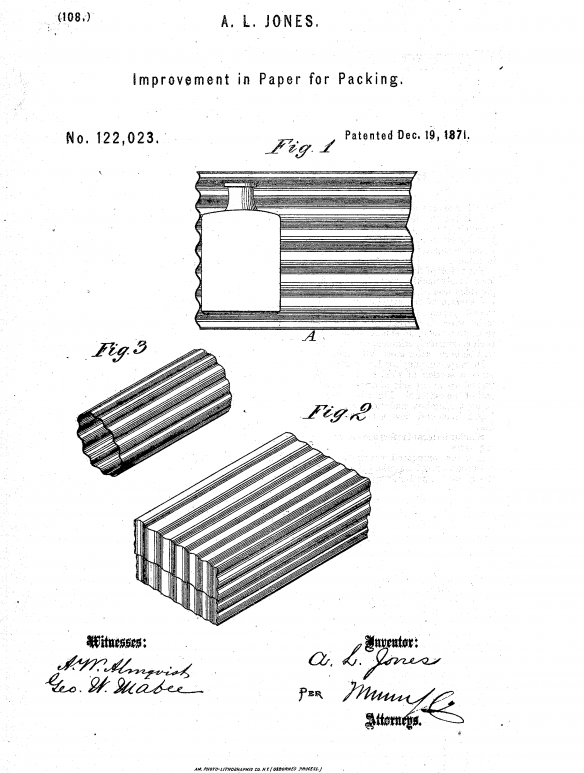
1871. Albert L. Jones was an American pharmaceutical technician dedicated to perfumery and concerned about the breakage of his bottles, since at that time there was no choice but to wrap them in cloth or straw to transport them.
Jones had the idea of substituting paper for cloth wrapping, but found that this was not enough, so it occurred to him to crease the paper to achieve volume and cushion the blows. This was the origin of corrugated paper as a protective packaging element.
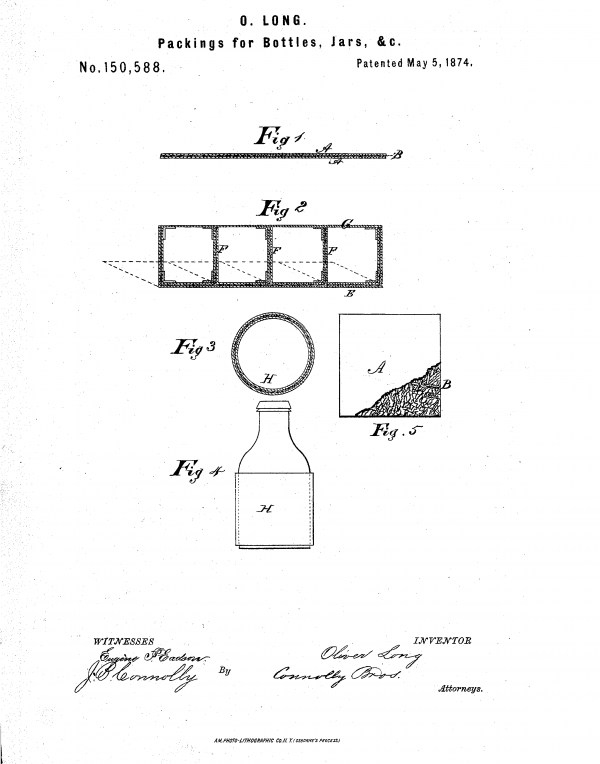
In 1874 Oliver Long, also a North American, appeared on the scene and invented what would later evolve as corrugated cardboard: a kind of sandwich made with two sheets of paper, between which strips or paper chips were glued.
And finally the inventor of folding cardboard boxes was the Scotsman Robert Gair in 1890. In his early days, Gair worked as a printer and was also dedicated to making paper bags. Later, in the 1900s, Gair went into the corrugated cardboard shipping container business, building an economic empire.
It all started casually, due to an accident. At Gair’s factory, an employee was printing paper seed bags and mistakenly changed the metal rule that was used to fold the bags, with the result that the bags were not only folded, but also cut.
Robert Gair realized that by taking advantage of this mistake, he could cut and fold the paper in one go. By applying this idea to corrugated cardboard, the production of cardboard boxes could be done faster and in greater quantity. This is the origin of American boxes (that is, folding boxes made of corrugated cardboard), and for this reason Robert Gair is considered the inventor of folding cardboard.
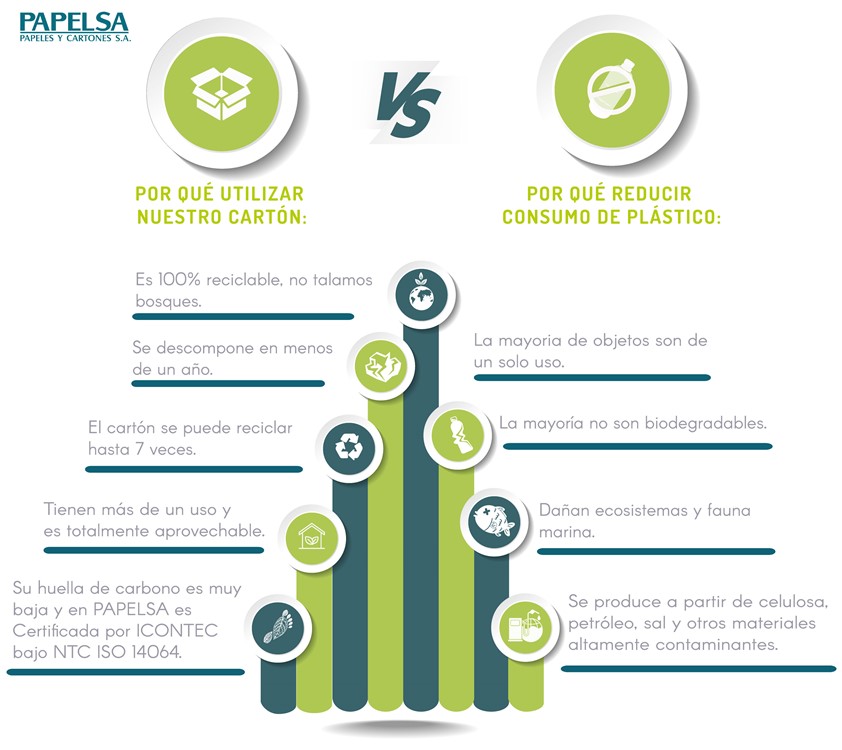
From those days to today, we have made many improvements to the manufacturing process, but thanks to these men, today we have corrugated cardboard, the most used material in the world for packaging all kinds of products, with properties such as durability, rigidity, adaptability, insulation, sustainable and recyclable.